Ultra-Processed Foods: How to Spot Them Just by Reading Ingredients
The phrase “ultra-processed food” has moved from nutrition research into everyday conversation. You have probably seen it in headlines, heard it in conversations about health, and perhaps wondered how it applies to the products already in your kitchen cupboard.
Here is the thing: determining whether a food is ultra-processed does not require a degree in nutrition science, a calorie counter, or a new app. It requires one thing the ingredient list on the back of the pack.
What Does “Ultra-Processed” Actually Mean?
The term comes from the NOVA classification system, a framework for categorising foods developed by researchers at the University of São Paulo, first published in a 2009 paper by Professor Carlos Augusto Monteiro. NOVA divides food into four groups based on the extent and purpose of processing:
- Group 1 : Unprocessed or minimally processed foods (fresh fruit, vegetables, plain meat, eggs, milk)
- Group 2 : Processed culinary ingredients (oils, butter, sugar, salt, flour
- Group 3 : Processed foods (canned vegetables, cured meats, cheese, freshly baked bread)
- Group 4 : Ultra-processed foods (UPFs)
Group 4 is defined as industrial formulations made up of substances extracted or derived from food such as sugars, starches, fats, and proteins combined with additives whose primary function is to make the final product palatable, visually appealing, and shelf-stable.
Critically, the NOVA definition is based on the ingredient list, not on the nutrient content. A product can be “low fat” or “high protein” and still be ultra-processed.
Why It Matters: What the Research Shows
The science on UPFs has matured significantly over recent years. A landmark 2024 umbrella review published in The BMJ draws on 45 meta-analyses involving nearly 10 million participants.
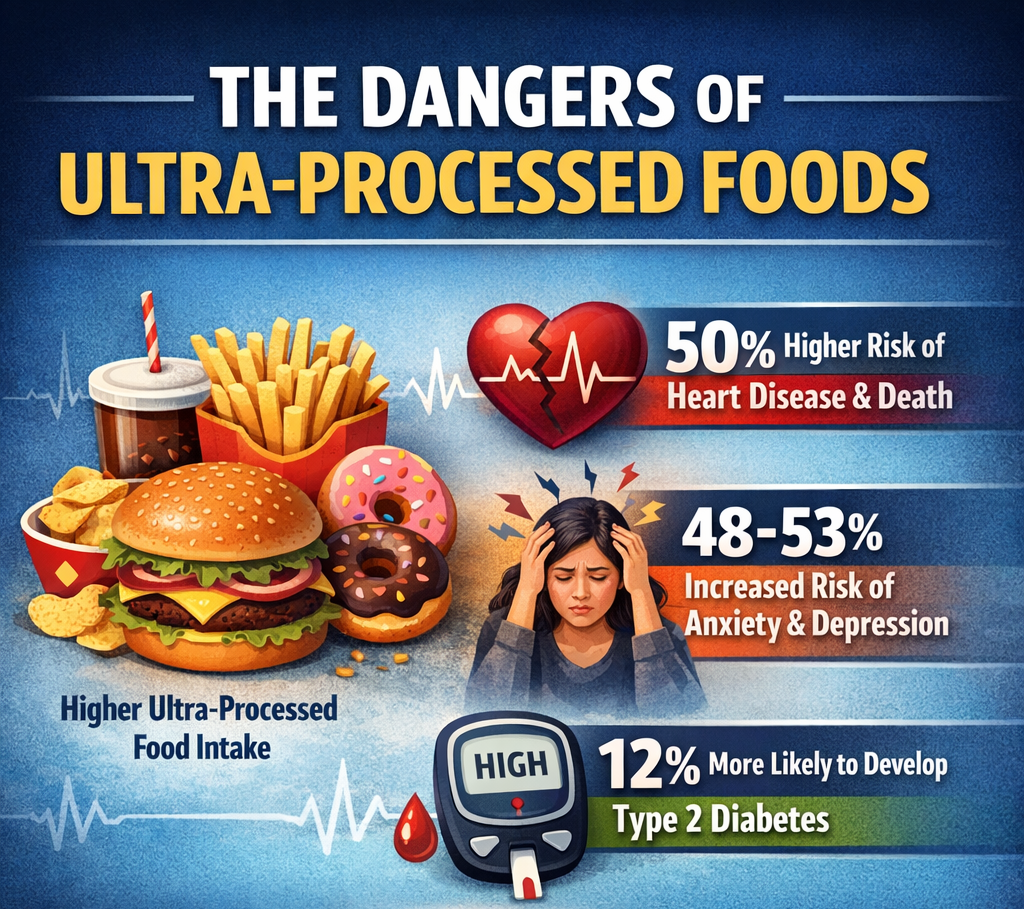
The study found that higher ultra-processed food intake was associated with around a 50% increased risk of cardiovascular disease-related death, a 48–53% higher risk of anxiety and common mental disorders, and a 12% greater risk of type 2 diabetes. The review identified associations with 32 distinct adverse health outcomes.
Separately, a 2024 dose-response meta-analysis covering 1,148,387 participants and 173,107 deaths found that each 10% increment in UPF consumption was associated with a 10% increased risk of all-cause mortality (Lane et al., BMJ 2024; and associated meta-analyses, PubMed 2025).
In the United States, the CDC reports that adults obtained approximately 56% of their daily calories from ultra-processed foods in 2017–2018, with children obtaining around 65.6% of their daily calories from UPFs during the same period.
It is important to note that while these associations are consistent and significant, researchers acknowledge that confounding factors cannot be entirely ruled out.
The NOVA classification itself is still subject to ongoing scientific debate regarding precision. What is clear, however, is that monitoring UPF intake begins with reading the ingredient list.
The Kitchen Test: A Practical Rule for the Label
The most accessible way to identify a UPF proposed in the original academic definition by Monteiro et al., published in Public Health Nutrition (2019) is what many refer to as the “kitchen test.” The question is simple: would you find this ingredient in a domestic kitchen?
Salt, flour, butter, eggs, sugar, olive oil, vinegar these all pass. Hydrolysed protein, high-fructose corn syrup, maltodextrin, interesterified vegetable fat these do not. If an ingredient list contains one or more substances that no home cook would keep in their pantry, the product is almost certainly a UPF.
Two Categories of UPF Ingredients to Know
According to the NOVA framework as published by Monteiro et al. (2019), UPF ingredients fall into two groups:
1. Industrial food substances (no culinary use)
These are substances derived from whole foods through industrial processes and found only in manufactured products. Spotting these in the ingredient list is one of the clearest signals:
- Sugars and syrups: High-fructose corn syrup (HFCS), maltodextrin, dextrose, invert sugar, fructose, fruit juice concentrates, lactose
- Modified fats: Hydrogenated vegetable fat, interesterified oil, partially hydrogenated oil
- Protein derivatives: Hydrolysed protein, soya protein isolate, whey protein isolate, casein, mechanically separated meat
- Starches: Modified starch (indicated by names such as acetylated distarch phosphate, hydroxypropyl distarch phosphate, or simply “modified starch”)
2. Cosmetic additives
These appear primarily at the end of the ingredient list and are used to give the product its intended texture, colour, flavour, or shelf life in the absence of intact food:
- Flavourings (natural or artificial)
- Flavour enhancers
- Colour additives Emulsifiers (e.g., mono- and diglycerides of fatty acids, carrageenan, lecithin when in a UPF context)Non-sugar sweeteners (e.g., aspartame, acesulfame K, sucralose, saccharin)
- Thickeners, gelling agents, anti-caking agents, foaming and glazing agents
The presence of even one ingredient from either list suggests you are looking at a Group 4 product under NOVA.
A Walk Through a Real Ingredient List
Consider two cereal products side by side. The first list: whole grain oats, almonds, raisins, honey. The second lists: Cereal flakes (maize flour, rice flour, sugar, barley malt extract), sugar, modified maize starch, glucose syrup, dextrose, salt, emulsifier (soy lecithin), flavouring, colours (carotenoids), vitamins.
The first contains only recognisable, minimally processed ingredients. The second contains modified maize starch, glucose syrup, dextrose, and artificial flavouring classic UPF identifiers, regardless of what the front of the pack says about vitamins or fibre content.
This is why reading the ingredient list, rather than relying on nutrition claims, is the essential skill.
Important Nuance: Not All UPFs Are Equal
The NOVA framework classifies foods based on the presence of UPF-marker ingredients, not by degree of harm.
A 2023 study published in The Lancet found that within the UPF category, breads and cereals showed no increased association with cancer or cardiometabolic disease, while animal-based ultra-processed products and artificially sweetened beverages showed the strongest associations with adverse outcomes.
This means the goal is not to avoid every processed item with a long ingredient list, but to become aware of which products rely heavily on industrial substances and cosmetic additives and to understand that front-of-pack claims offer no protection from that reality.
Nutritional labels note: While the ingredient list tells you what is in the food, the nutritional panel can help you understand how much added sugar, sodium, and saturated fat is present. For products with extensive UPF-marker ingredients, high values in these columns reinforce the picture. Both sides of the label are worth reading together.
What to Do at the Shelf
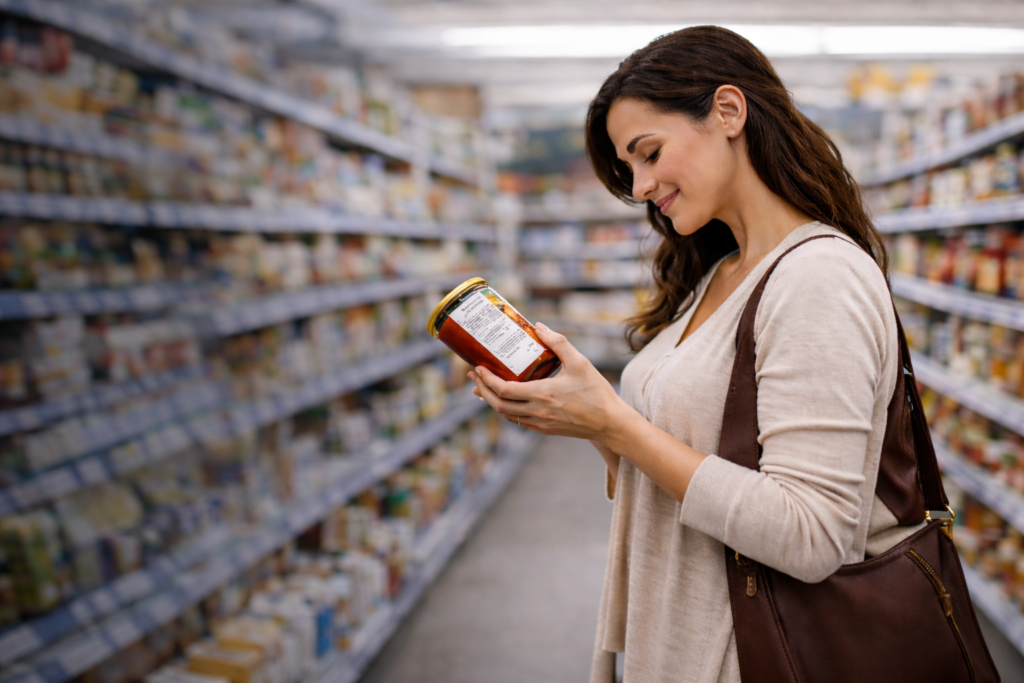
- Turn the pack over. The front is marketing. The back is evidence.
- Read the ingredients, not the claims. “High in protein” and “source of fiber” are not indicators of minimal processing.
- Apply the kitchen test. If the ingredient list contains substances you would never find in a home kitchen, flag the product as likely ultra-processed. Look at the mid-list. Industrial food substances tend to appear in the middle of the ingredient list, while cosmetic additives cluster at the end.
- Use the database. At CheckTheLabels.com, search any unfamiliar ingredient, including E numbers, modified starch variants, and protein isolates, for its function, origin, and regulatory status.
The ingredient list is not there to confuse you. Once you know what to look for, it is one of the most transparent and consistent pieces of consumer information available.
Refer our article on different types of additive: here
Sources:
Dai S et al. “Ultraprocessed foods and human health.” Clinical Nutrition, 2024;